
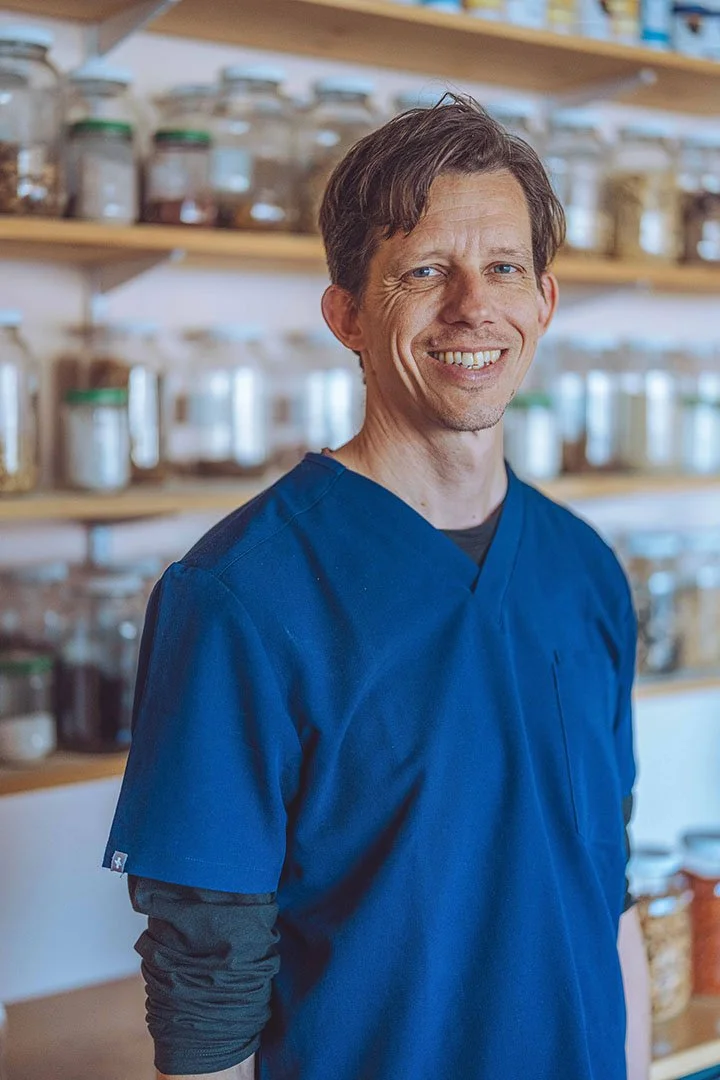
Stefan Grace
Instructor
My journey with Chinese physical culture started 30 years ago – a taiji class on a whim that would eventually lead to lifelong wellness and purpose. The immediate effect of those initial taiji classes in my early twenties was an energetic buzz and clean feeling that I couldn’t get enough of. Practicing and teaching internal martial arts still has that effect.
Through the North American Tang Shou Tao Association (NATSTA) in Arizona, I began my training in baguazhang and xingyiquan under NATSTA founder Vince Black and other world class teachers. I was very fortunate to spend time throughout the US, Thailand and China, learning directly from the last generation of the old guard – the Chinese masters who carried the knowledge of internal martial arts and Chinese Medicine beyond revolutionary mainland China. They risked everything to bring these things forward and then elevated their practice to extraordinary levels.
NATSTA founder Vince Black had a great way of bridging the cultural divide and teaching these ancient lineages of Chinese wisdom in a way that us Americans could understand. He reinforced the philosophy that optimizing health through gong fu requires more than the practice of martial arts, it’s also about learning and incorporating the Chinese healing arts. This spurred my own education in and professional practice of medicine like acupuncture and tuina, modalities that continue to inform and elevate my physical culture practice.
Credentials
Instructor: Shen Long Xingyiquan, North American Tang Shou Tao Association
Instructor: Jing Luo Qigong, North American Tang Shou Tao Association
Extensive training experience with following teachers and styles:
- Shen Long Xingyiquan (Vince Black)
- Soft Body XIngyiquan (Li Runxi)
- Hero Mountain Xingyiquan (Li Cang)
- Cheng School Gao Style Baguazhang (Liu Shuhang)
- Liang Zhenpu Baguazhang (Vince Black)
- Yang Style Taijiquan
- Jing Luo Qigong (Dr. Li Ding)
Part of the ethos of NATSTA is that one needs to teach in order to gain a deeper understanding of a practice like xingyiquan. While I didn’t immediately gravitate to this teaching role, it has become something I enjoy doing for altruistic reasons, and also selfishly since it does positively affect my own practice. My teachers at NATSTA were serious about what they were teaching, but not too rigid. This is something I try to recreate in my own classes – helping people feel relaxed and comfortable while still getting things done.
My enduring personal commitment to practicing Chinese physical culture comes not just from the immediate effects I feel, but more importantly the preservation of my health. When I was training with one of our senior teachers from China and I saw him moving around like he was in his twenties, I knew this was the key to aging gracefully. For fifteen years I have been teaching these practices to others so that they too can reap these health benefits and reduce their reliance on a broken medical system. Unlike a pill, it’s medicine that takes day by day consistency, but it is very much worth it.